 Two Eliminations for the Price of One
Padma’s back in bright yellow and she takes us down memory lane of Top Chef’s past, with San Francisco, LA, Miami and last year’s Chicago. But now the highly rated food show on TV has made it, and to prove it they’re going to the Big Apple baby. There’s a quick montage of the 17 cheftestants this season. Hey, is that someone in a bikini?
What’s at stake you might ask? Padma, can you give us the rundown? Hmm, sounds pretty much like the same prize package every year: a feature in Food & Wine magazine, a showcase at the Food & Wine event in Aspen, $100,000 from Glad, and, oh, what else? Um … the title of TOP CHEF.
Cue the dance music. Oh how I missed this silly montage. I’m not even going to bother mentioning all the cheftestants flashing briefly before me right now, although I have to say they’re a bit more awkward dancers than what I recall of previous seasons. Did some guy just wink at us? Oh boy, it’s going to be that kind of season.
We open with scenes of a New York farmers market, then Whole Foods (since when is that a New York landmark?), and Grand Central Station. Fabio is the first to arrive with his wheelie bag, and if you haven’t guessed it, he’s from Italy. Florence specifically (or what I like to call Firenze, which is the proper Italian name for the city—bastard westernization of foreign cities!). You can tell he’s Italian by the way he says “frickin’.” Then we have Jamie who’s the only chef this year from San Francisco (woo-hoo!) and she has a lot of tats.
 Oh wait, I’m wrong. This guy Eugene from Las Vegas via Hawaii has way more tats. The rest of the parade of cheftestants include Jeff, a surfer blond from Miami who I’m going to call Jeff the Hair because he says he always checks his hair before he goes into a restaurant; Radhika, who’s Indian but says she doesn’t want to be pigeon-holed into cooking only with Indian spices (although she does just that in the first quickfire challenge); and Lauren, a Southern girl from Savannah with a husband in Iraq (bring the troops home Obama!).
Now they’re on a ferry outside of Manhattan. We meet more cheftestants, some of which don’t even rate a few minutes of bios. They’re just too many of them. Looks like Southern Girl Lauren knows Patrick, the 21-year-old culinary student (he didn’t even graduate yet). They were in some class together, so can there be an alliance brewing?
This guy Stefan is from Finland, and you know how most Europeans know more than one language so he’s busy talking Italian to Fabio. It looks like they’re heading to Governor’s Island near the Statue of Liberty, and this cheftestant Richard blurts out for no apparent reason that he’s a big ol’ queen. In our community, he would be known as a “bear.” (Just like how they tried to stick that label on Tom Collichio but he wouldn’t hear of it.)
Speaking of Chef Tom, there he is in all his shiny baldness next to the fabulous Padma, who welcomes them to the most competitive environment yet. (Is that kind of like the most suspenseful rose ceremony ever?) She announces the first quickfire challenge, but tells them that there are 17 of them but only 16 chef’s jackets back at the Top Chef kitchen. So one person will be eliminated from the quickfire. (I had read about this in some early press so I wasn’t shocked about it, but it kind of sucks for whoever gets kicked out in the first 20 minutes of the show.)
 Chef Tom tells them they’ll be tested through three rounds of culinary skills, all involving the bowl of apples (get it?) in front of them. For the first round, they all have to peel 15 apples using a knife instead of a vegetable peeler. Oooh, I bet there’ll be a lot of bleeding in this segment.
They’re off, and everyone starts peeling, and sure enough I already see some blood. Ouch, some big guy (I still don’t know everyone’s names) just said he cut through his thumb and he says he has to keep on going even if his thumb falls off. Nice. Stefan finishes first, and actually gets immunity for the elimination challenge (just for peeling apples?). The next eight will be safe while the remaining losers move on to the next round. Jamie from San Francisco doesn’t want to have to do the second round, but there’s just one more spot left for safety and … she’s safe. Whew! Give her a shot of absinthe, people!
In the second round, we learn a new fancy culinary French term known as “brunoise.” So kids, what that means is they have to dice the apples into tiny little perfectly identical squares.
Four cheftestants brunoise their way to safety so that just leaves four others for the third and final round of skills. Leah, who’s from New York, Lauren with the military husband, Patrick the culinary student and Radhika, who doesn’t cook with Indian spices. Tom says they have 20  minutes to make a dish from the apples. Radhika just said in her interview that it takes her 20 minutes just to get her knives together, find her pots and get her spices. Geesh, girl, how slow do you cook in the kitchen? Do you know you’re in a competition?
Anywho, Radhika says she’s going to make an apple chutney. Huh, that sounds vaguely like Indian food to me. Leah is making seared scallops, which is smart because they’re fast to cook, and friends Lauren and Patrick are both making salads.
Tom and Padma go to the four stations to try out their dishes, but they don’t really say much. Then Chef Tom gives his appraisal, starting with Leah’s dish, which he thought was well seared and Radhika, which was well seasoned and balanced. Both are declared safe.
So that leaves the buddies Lauren and Patrick. Not only do we get our first elimination for the season, but the producers are already breaking up this heart-felt reunion. Oh, this is so like “Sophie’s Choice.” OK, maybe not, but still.
Commercials. I don’t get that “Australia” movie with Nicole Kidman and Hugh Jackman. It looks all epic and such, but what is it about? Are they going to do the history of one country in two hours? Is it a musical? I know how Hugh loves his musicals. (wink) You know another commercial I don’t get? That British Airways commercial with sea lions and other sea creatures swimming around like they’re at an airport. What is that  supposed to mean? Fly British Airways, and sit next to a smelly sea animal. I can’t believe in this economy some company is paying someone to come up with these.
Back at Governor’s Island, Chef Tom says both Lauren and Patrick’s salads were good, but he has to go with Patrick’s. So that means Lauren has the honor of being the first to go home, and she didn’t even cook for the guest judge. Brutal.
Padma busts out the knife block and they’re already into the Elimination Challenge even before these guys have unpacked. Wow, New York season is tough. As they pull knives, they’re words printed on the sides like Astoria, Chinatown, Brighton Beach, and I can tell already that it has something to do with New York’s neighborhoods. Everyone who comes to New York always have to do something about the city’s distinctive neighborhoods, which are mostly in the boroughs.
 Turns out that the group is divided into pairs, and each pair will have to make a dish inspired by their neighborhood. And for each pair, they’ll go head-to-head in judging and one person will move forward and the other will be “eligible” for elimination. Now that they know the rules, everyone’s dismissed and they head to their new digs.
They arrive at their new home, which looks like some new loft or condo, and there’s the typical ooohs and aaahs. I can’t tell from the view exactly what neighborhood they’re living in, but my guess is somewhere on the lower west side because I think I see Jersey over there. Lauren and Richard the Bear are out on the patio and they call themselves Team Rainbow (as in the LGBT rainbow flag). We already knew Richard was a self-declared big ol’ queen, and now we know Jamie is a lesbian. (She is from San Francisco, remember?) They drag young Patrick into the group because, you know, things are better in threes.
Inside we see subtitles whenever Stefan and Fabio are talking. I don’t know why, because I can make out what they’re saying. Blah blah blah, football, blah blah blah, marijuana, blah blah blah where’s my cigarette? Stefan gets into a fight with someone about how vinaigrette is vinaigrette. You can tell the editors are making Stefan out to be the Marcel or Stephen of this season, the pompous know-it-all. Except he’s a European pompous know-it-all.
Commercials. Another movie that I don’t get. All I know is it’s about a boy with a British accent who wears striped pajamas. Two words: Oscar whore.
The cheftestants wake up and get ready, and we get the typical worries from people who are out of their element. Eugene is worried because he’s going to Little India and needs to cook Indian food, which he’s never done before. Ariane is just a whole bag of self-esteem issues.
For the next few minutes, we see the pairs shopping at neighborhood grocery stores and discovering different ethnic foods. They have $75 to spend, and the only interesting moment is when we find out more about Carla, the tall woman with a big bunch of frizzy hair on top. She’s in Brighton Beach, which is primarily a Russian neighborhood, and she can’t decide what to make. She says she’ll let the “spirit gods” guide her to find out what she’s supposed to make. OH-kaay.
 Young Patrick and this big guy named Daniel is in Chinatown. And I love New York’s Chinatown because it’s crowded and gritty and so ethnic. But Patrick is in the aisle of a grocery store and he’s looking at Japanese noodles! Hell-no. You’re supposed to be inspired by Chinatown, not Asiatown. So he grabs a bag of black noodles, which I suspect is Japanese soba or black sesame noodles and he heads out. (I hate it when they confuse Asian cultures, like we’re all the same or something.)
Everyone returns to the condo building, which is also where the Top Chef kitchen is. The cheftestants start cooking and we get the fast-paced cooking music, along with a lot of sweaty people. I guess with the camera lights, it can get pretty hot in the kitchen.
Fabio is paired with Jeff the Hair and he’s feeling pretty confident that his pork slices with mango demi-glaze will be more Latin than Jeff’s. Jeff is busy creating sides like crispy plantains.
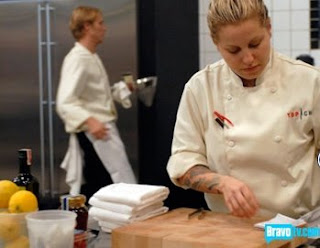 Here’s young Patrick making his Chinese dish with Japanese Mirin (the sweet rice wine) that he’s going to use as a glaze on a salmon. He’s cooking his black noodles but it looks like he overcooked it because he says the texture is off.
Richard is trying to talk to his partner and fellow Team Rainbow member Jamie, but Jamie is fun outside but serious inside. So she’s not the talkative type when she’s in the kitchen. I bet Richard wants to revoke her Team Rainbow card right now.
Ariane is over-tasting her faro that she’s cooking, and she says she tastes it again and again to the point she doesn’t know any more if it’s seasoned or not. Wow, she’s a disaster just waiting to happen, isn’t she?
Just seven minutes left and everyone’s rushing to plate, and Jeff the Hair is totally caught off  guard. It’s the typical “too much on his plate” scenario and now he’s running back and forth between the stove and his station to finish the dish. And you guessed it … Jeff doesn’t finish plating his dish.
Commercials. Now that’s a better Glad commercial with the cutie kid. It’s not surprising but at least it’s not creepy.
Back in kitchen, we find out the first guest judge for the season is New York legend Jean-Georges Vongerichten. Padma introduces the other judges: Chef Tom and Gail Simmons of Food and Wine. They head off to the judges’ table, which is right in the kitchen and looks so casual with the wooden table, like they’re at some kind of picnic.
 Since they’re so many cheftestants, here’s just a quick summary of the dishes:
Neighborhood: Long Island City (Middle Eastern). Stefan’s lamb chops with tabouli salad trumps Ariane’s undercooked faro risotto with lamb.
Neighborhood: Astoria (Greek). Richard’s (who sends some love over to fellow bear Tom) Greek lamb sliders with orzo salad is too plain next to Jamie’s deconstructed Greek salad with seared bass.
Neighborhood: Jamaica (Jamaican). Jill’s overcooked scallops with plantain fritters and jerk-spiced salad was still better than Radhika’s jerk-rubbed halibut and three-bean rice.
Neighborhood: Ozone Park (Cuban/Latin). Fabio’s sous vide-prepared pork chop with roasted mushroom wasn’t Cuban enough next to Jeff the Hair’s pork tenderloin with Cuban coffee.
Neighborhood: Brighton Beach (Russian). Hosea’s trio of smoked fish (pretty plating) demonstrated “culinary elegance” (Padma’s words) so he wins over Carla’s smoked trout over potato latkes.
Neighborhood: Little Italy (Duh). Leah’s faro risotto and snapper wins over Melissa’s seared rib eye with tomato sauce.
 Neighborhood: Chinatown (Chinese!). Daniel’s generic Chinese Chicken Salad (which is an American-invented dish) trumps young Patrick’s Japanese-inspired seared salmon over black noodles.
Neighborhood: Little Indian (double duh). Alex’s grilled lamb chops with ragout didn’t have any Indian flavors while Padma herself declares Hawaii boy Eugene’s masala-rubbed lamb as a classic Indian home-cooked dish. Wow, he totally lucked out on that.
Tom says he’s happy with what he’s seen so far this season, but he did leave some criticism for young Patrick, saying his dish didn’t represent the neighborhood (I sooo agree). They continue talking about their likes and dislikes, and as usual they’re all over the place.
Commercials. We’re at the one hour mark and this premiere is a special 75-minute long show. I’m going to be soooo tired. Why did I decide to do these recaps? Ugh, those Xbox commercials looking into the brains of people is really creeping me out.
Night-time in New York. Padma comes and rounds up the winning group of Stefan, Eugene and Leah. And she also brings in the losing group, young Patrick and Ariane. Ariane is worried she’ll be the first voted off. Wrong show, girl, unless that’s Jeff Probst I see standing behind the camera eating that leftover piece of lamb.
 For judgment time, they draped a table cloth over the judges’ table and turned on the mood lighting. They discuss the winning dishes, and Tom says Leah captured the flavors of new Italian cooking. Chef Jean-Georges, who’s kind of soft-spoken and also needs subtitles, says he liked Stefan’s dish. Padma is still raving about Eugene’s classic Indian dish, and Chef Jeans-Georges says the masala was “divine.” But for the winner, he gives it to Stefan, who hopes to be the first Top Chef from Europe.
So that leaves Patrick and Ariane. It’s a good sign that the cheftestants’ dishes were so good that they only have two in the bottom instead of the typical three. But it most be so embarrassing to be those two. Which brings us back to young Patrick and Ariane.
 Chef Tom says Patrick’s dish wasn’t inspiring and Gail says it tasted like the same texture. She says it doesn’t say Chinatown. (Of course not, because it’s a Japanese dish!) Tom tells Patrick he needs to travel more and discover the other world tastes. Ariane says something about how she looks at cookbooks and that creates a dramatic thunk with Tom, who says cookbooks are for kids.
Padma asks them the silly question of why they should stay and I really don’t get their answers, so let’s just find out who leaves. Oh wait, they need to talk about it more. Maybe they’re still trying to figure out if the bok choy Patrick used with his dish is Chinese or not.
Finally, it’s judgment time. Chef Tom says Ariane’s dish was inspiring but lacked technique. Patrick’s dish was well-executed but not inspiring. Padma looks over at Tom, who gives her the death nod, and then she turns to young Patrick and tells him to pack his knives and go.
Patrick hugs everyone bye, and they’re so many of them at this stage he doesn’t know if he hugged everyone yet. Then he jumps on Richard the Bear, who probably would like it if he wasn’t into other bears. Patrick says he’ll go back to culinary school, because he has an exam next week. Then he’ll be Top Chef in the year 2012.
This season on Top Chef: Lots of fire, lots of running, Fabio fighting, Jamie getting offended by Stefan, Martha Stewart arrives, Rocco Dispirito never left from last season, and Ariane is still a whole bag of self-esteem issues.
“Top Chef: New York” airs every Wednesday at 10 p.m. (9 p.m. Central) on Bravo TV. Photos courtesy of Bravo TV’s Web site.
Summary only...

 Welcome Home Chef Sean O’Brien
 So when the chef returned to the city’s food scene with the opening of Zinnia last month, I didn’t waste any time in getting myself over there. And I dragged my fellow food blogger Foodhoe with me. (OK, I really didn’t have to do much arm-twisting on Foodhoe’s part since she has eaten at Myth before and knows the talents of O’Brien.)
 Foodhoe recognized a few items that Chef O’Brien served up at Myth, namely the seared sweetbreads and potato gnocchi. We both—for the briefest of moments—contemplated ordering the Black River Oscetra Caviar starter with Potato Cakes for $79, but thought better of ourselves.
 Next Foodhoe got the Seared Mascarpone Potato Gnocchi with Wild Boar Bolognese ($14). The gnocchi was a bit larger than what I normally see when eating gnocchi. They looked almost like tube pasta and they had a nice seared coloring on them. Foodhoe says she’s had it with a cream sauce, and preferred that to the Bolognese. I actually didn’t mind the Bolognese sauce, which was a rich and flavorful meat sauce. But both Foodhoe and I agreed that the gnocchi were a bit on the gummy side, almost as if they’ve been overcooked.
 I had a small order of the Seared Scallops ($15/$26) with mushrooms, crispy potatoes, fennel and lobster sauce. I love any kind of seared scallops, but this dish was a little underwhelming. First, it looked awfully brown for some reason and the searing didn’t produce that nice, tasty caramelization on the scallops. It just made it looked brown bordering blackened. The sauce was rich, but didn’t have a distinct flavor other than cream.
 For our entrees, I went with the Quail ($17) stuffed with quinoa and king trumpets and served with arugula and orange slices. The quail was nicely prepared, with the bones so cooked that they basically broke away at each bite. The addition of the oranges gave it a bright, clean flavor but not something I haven’t tried before.
 Foodhoe got a small order of the Roasted Alaskan Black Cod ($16/$27) served with baby shiitake mushrooms, butternut squash and sitting on a stewed piece of daikon (Japanese radish). The dish was finished off with a clear dashi broth poured on at table side.
 Side note: The service was friendly and attentive, but the timing of the courses seemed too spaced out. There was a lot of time in between our courses, which made our school-night dinner last more than two hours. I don’t know if this is a reflection of the opening month kinks in the kitchen or Chef O’Brien’s deliberate take to provide diners with the European approach to long dinners. I’m not a fan of long waits between courses, unless I’m on vacation.
 It was a beautiful evening as we left the restaurant, and being the shutterbugs that we are, Foodhoe and I got into a competition to see who could get a photo of the restaurant sign with the night's moon and the nearby TransAmerica building. I only could get two of the three.


