Sunday, June 12, 2011

Bites on Broadway in Oakland

Last Friday night kicked off "Bites on Broadway," Oakland's version of the now-established food truck movement.

Not only was I excited about a kind of "Off the Grid" in Oakland, but it's literally one block away from my apartment in the Rockridge/Temescal neighborhood of North Oakland. Bites on Broadway was created by community organizer and foodie Karen Hester, who wanted to help revitalize Oakland's Broadway.

Initially, the event was promoted to take over the front lawn of the Oakland Tech high school on Broadway and 45th, which would have been a prominent spot along Broadway. But when I walked over, I didn't see anything and worried that I got the date wrong. Then I looked down 45th and saw two or three trucks parked on the side of the school on the street.


Five vendors made it for the inaugural Bites on Broadway: El TacoBike, Fist of Flour, Go Streatery, Sue's Sassy Pies, and Tina's Tamales. People started lining up and people had to find places to eat on the school steps or along the wall because the grass was totally muddy from the week's earlier rain. Having the event on the side really made it seem like a pop up event, and supposedly the school wouldn't allow an event on the front lawn. (What is this? Jamie Oliver's Food Revolution?)

After giving a quick once-over of the five vendors, I decided to stand in line for food at Go Streatery, who was serving up pulled pork sandwiches, salads, and oxtails with grits. Go Streatery had the longest line at the time, but I was patient and was rewarded with this amazing bowl of oxtails ($8.50).
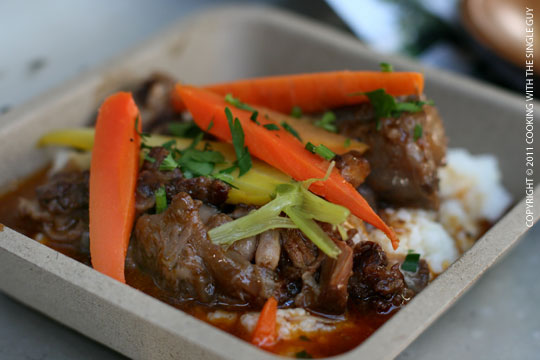
The dish was beautifully presented with heirloom baby carrots on top of the oxtails. It really looked like a dish you'd find at a restaurant. The oxtails were tender, falling off the bone and had a nice flavor. It may not have a lot of complexity, but it was hearty and a great Friday night dinner. (I also got a cup of lavendar lemonade, $2.)

After enjoying my oxtails, more and more people started to arrive and the lines got longer but I wanted to try something else. So I got in line at Fist of Flour for its pizzas. As I waited, I saw more people leaving because some of the other trucks started to run out of food by 7 p.m. (the event started at 5:30 p.m.). I think the lines were long because so many people wanted to check out the food trucks and there weren't enough of them dishing out grub.

The organizers set up some games for the kids, but that wasn't enough to really keep people busy as they waited for food. Eventually, Fist of Flour became the only truck left with food for sale, which made my line long and slow. I actually stood in that line for close to 1.5 hours. I know, crazy, but sadly I had nothing else to do on a Friday night and it's like an extra innings baseball game when you're already invested and you can't leave.

I eventually got half a pizza (they made a meat version with ham, cheese, mushrooms, and arugula) for $8 and walked back home to eat it while watching the Giants game. It was chewy with a few crispy edges, with a nice flavor in the sauce. Was it worth the 1.5-hour wait? Probably not, but like one woman said in line, "it's all for the experience."

I hope the people behind Bites on Broadway have learned from this first experience, and hopefully they can get a better location more fitting for an event instead of squeezed on the side of the street. Bites on Broadway was promoted to be a weekly Friday night event for the summer, but I wonder how successful it'll be considering several people left looking disappointed or rejected. It's going to take a lot of good word of mouth to get these people back.

For me, it's easy for me to check in on this food truck event because it's so close to my home. Here's hoping that it improves and continues because these food trucks deserve a solid audience.

Saturday, June 11, 2011

Yogur Story in Honolulu

Many Tales are Spun at this Cafe
815 Keeaumoku St. (on Rycroft), Honolulu
Ala Moana
PH: 808.942.0505
Open daily, 8 a.m. to 10 p.m.
Reservations, major credit cards accepted

HONOLULU

It's hard to describe the restaurant known as Yogur Story. Is it a frozen yogurt shop? Is it a cafe? Is it a restaurant? Nobody knows, but it's probably a little bit of everything.

That's what puzzled my niece when we went there for dinner one night. There's no story behind Yogur Story, other than someone didn't know how to spell yogurt. Walking in, the spacious bright area with a mezzanine area looks like the lobby of a grand hotel. But the casual tables and self-serve frozen yogurt dispensers say otherwise.

Side note: If you follow the address you might also be confused because the entrance is not facing Keeaumoku, which is the main thoroughfare leading up to Ala Moana Shopping Center. Instead it's off Keeaumoku on Rycroft, with parking in the front.

A local review of the place, which opened in late 2010, explains that the concept behind Yogur Story is very common in South Korea, where the tart fro-yo that's invaded the States originally came from. (The owners are Korean-Americans.) To me, it has a real coffee house feel except it doesn't have wi-fi.

My sister and brother-in-law said they came here on a Sunday morning to meet some friends, and the place definitely seems like a great place for breakfast with the airy feel and patio seating. For the dinner menu, Yogur story had a mix of Hawaiian favorites and a few entrees.

My brother-in-law ordered one of the restaurant's signature dish called the Fat Pig Fried Rice ($13.95), supposedly because of the pork adobo shredded meat blended in with the rice. The dish even comes out looking like a face with two eggs serving as the eyes and slices of Portuguese sausages as the mouth. (They call the eggs "oinker up.") To me, the dish symbolized the typical serving portions of food in Hawaii and it's so aptly named.

My sister ordered a simple Caesar salad, and my niece and I both ordered the same entree, which was Ahi Del Rey ($17.95), a tuna fillet encrusted with black sesame and topped with a sauce that I forgot the ingredients. The dish was plated like one you'd find at a high-end restaurant, and I did like the sauce and flavor of the fish although it was near done while I generally prefer my tuna to be seared on the outside and nearly raw in the center.

Throughout dinner I kept staring at the self-serve fro-yo dispensers, which looked closed because the lights above them were dark. So we thought maybe the yogurt is served during the day, but when our server said we could go up and help ourselves, my niece and I went up to get some fro-yo for dessert.

There were only four flavors: original, taro, honeydew and orange cream. I got everything except taro, and while I liked the flavors, I thought the texture of the fro-yo was more icy than creamy. If I were to rank the fro-yo in my Bay Area ranking, it would be in the bottom 20 percent. My niece, however, is not a fan of ice cream and the texture of Yogur Story's fro-yo reminded her of sorbet so she enjoyed it. So if you like your fro-yo more sorbet like than ice-cream like, then you'd probably like it too.

Because Yogur Story looked like it was more known for breakfast, I returned with my Mom on my last day in Honolulu before my flight home. Since it was Monday morning, the place was pretty empty, but it had a relaxing and casual feel.

I got the regular breakfast of two eggs and choice of meat. I got my eggs scrambled with Portuguese sausage. You're offered a choice of rice (very Hawaii) or herb-roasted potatoes. I got the potatoes but they actually were quite soft and not very crispy. The plate also came with a lot of toast and some fruit.

My Mom ended up trying their waffles. Yogur Story actually had a lot of creative waffles like red velvet and sweet potato. But I knew my Mom would think they were weird so I ordered her the regular classic waffles with fruits. The plate came out looking pretty big and she said she enjoyed the waffles, which had a nice crispy edge. Another sign of how Yogur Story is confusing, my Mom's waffles came with a side of frozen yogurt, which she passed on because she doesn't like eating cold things in the morning.

Even after visiting twice, I'm still not sure I know the story behind Yogur Story. But if it sticks around for awhile, you can make up your own story because it has that feel of being someone's regular hangout. The food seems to be all over the place, but it seems to be more a place to gather for more than the food.

Single guy rating: 2.5 stars (Something for everyone)

Explanation of the single guy's rating system:
1 star = perfect for college students
2 stars = perfect for new diners
3 stars = perfect for foodies
4 stars = perfect for expense accounts
5 stars = perfect for any guy's dream dinner

Thursday, June 09, 2011

Mana Bu's Musubi in Honolulu

HONOLULU
Hawaii is known for several food traditions and one that's high on the novelty list (because no one on the mainland would want to eat it) is the Spam musubi.

Hawaiians love the canned meat product, and they often eat it in a musubi, a Japanese traditional rice ball eaten by plantation workers who could easily pack a rice ball for lunch. But the Spam musubi isn't the only way to go when it comes to rice balls and the Mana Bu shop demonstrates that with its variety of specialty musubi.

Mana Bu promotes itself as "Hawaii's Musubi Headquarters" and it's hard to dispute that when you walk in and see shelves upon shelves of musubi. The place is so popular that the hand-made musubi often sells out by lunch. When I dropped by one afternoon after closing, I was totally confused by the sign out front on its hours. Instead of noting when the store opens, it notes when they begin selling certain popular musubi, such as 6:30 a.m. for white rice musubi, and 7:30 a.m. for all the rest, and so on. It was a bit confusing.

I returned on Saturday, when the store opens at exactly 9 a.m. I arrived early and waited for the doors to open and by 8:59 a.m. a crowd of people suddenly appear, filling the tiny store when it opened a minute later.

The flavors of the musubi varied, and they were either wrapped in nori (dried seaweed used in sushi) or naked with just a rice form. The flavors ranged from the traditional, such as a Spam lite version, to the exotic, like a Veggie Curry Pilaf. I bought about a dozen musubi for my family since that night we were going to my niece's graduation and I figured we might want a snack while waiting as they called out the names. The musubi range in price from $1.40 to $1.70 for each one.

Mana Bu also has a refrigerated section selling desserts like custard and gelatin, but probably one of its unique items is this whole strawberry mochi, which is basically a chocolate-covered strawberry wrapped in mochi, the sweet Japanese rice flour.

I didn't try the strawberry mochi, but I did eat several of the musubi. My family didn't seem to like the baked musubi because they tended to be dry, but the white rice musubi were perfectly cooked, fluffy but not sticky or dry (I had an unagi version), and the brown rice versions were also interesting. Some of the ingredients were refreshing, like shiso, while others didn't deliver, like spicy takuan. Still, Mana Bu is a tiny bit of rice heaven on Earth if you're looking for a nice snack to take to the beach or picnic. Just remember to go early.

Mana Bu's, 1618 S. King St. (at Punahou), Honolulu. PH: 808.358.0287. www.hawaiimusubi.com

Wednesday, June 08, 2011

Malasadas at Leonard's Bakery in Honolulu

HONOLULU
People who grew up in Hawaii will probably find it hard to believe that I've never stepped into Leonard's Bakery, home of the infamous malasada.

Don't get me wrong, I've eaten malasadas from Leonard's. But I usually got them at the Leonard's truck parked at carnivals and fairs. And I always enjoyed the airy Portuguese-style donuts coated with sugar that would get all over your clothes and around your mouth.

For many years, the malasada was why people visited Leonard's Bakery in Kapahulu, the neighborhood before Waikiki. And in recent years, Leonard's have expanded its malasada offerings, moving from the classic sugar-coated malasada to include li hing flavored malasadas (li hing is a Chinese flavoring used for preserved plums) and filled malasadas (think jelly donuts gone Hawaiian style).

So after dinner with my family one night, I suggested that we get some malasadas. Arriving at Leonard's, which remains open at night for people with the munchies along with tourists, I thought I'd find a fancy slick bakery. I mean, these people probably made millions selling malasadas.

But walking inside, the bakery looked like it probably did when it originally opened in 1952. It was a tiny bakery, with a small neighborly feel and a variety of baked goods in the glass counter. None of the malasadas are on display because they're kept fresh in the back where someone's probably making them non-stop.

The coated malasadas sell for 90 cents each, but are a bit cheaper by the dozen. I got half a dozen for $5.66 (three classic and three cinnamon coated). Then I added one each of the three filled flavors sold at $1.25 each (custard, dobash, and haupia). With my box of warm malasadas, I headed home for the taste test.

The classic sugar malasadas were what I remembered, really fluffy but messy to eat. As an adult, maybe now the malasadas might be too sweet for me. The cinnamon malasadas actually was disappointing because I could barely taste the cinnamon in the sugar.

And here are the three filled malasadas. I cut each one in half so you could see the filling.

First up was the custard, which is one of my favorite things. The custard from Leonard's had a nice texture and held up nicely when biting into it. BTW, the malasadas, filled or not, are quite big so you can get filled by just eating one or two. Can you imagined I ate just half of each of the filled and two of the regulars. I could barely sleep as my stomach was busy digesting dinner and my malasadas.

The dobash is a chocolate flavor that's very popular in Hawaii. Dobash cakes are standard for most bakeries, and is supposedly not as sweet as straight chocolate. The dobash squirted out as I cut into the malasada, so it was more wet than the custard. But I did enjoy the dobash filling, with a milder chocolate flavoring as advertised.

The last filled malasada is the haupia, which is a classic Hawaiian pudding made of coconut milk. The haupia barely stayed in the malasada after I cut into it. And while I enjoyed the haupia, it wasn't necessarily exciting and it was difficult to eat.

Of all these malasadas, I have to say I'm old-fashioned and probably would have been happy with just the classic. I also heard there's a new bakery in town competing for the malasada crown, but I didn't have time to compare the two. But it would have a big challenge ahead to topple the malasada king that is Leonard's.

Leonard's Bakery, 933 Kapahulu Ave., Honolulu. PH: 808.737.5591. Open 5:30 a.m. to 9 p.m., Sunday through Thursday; and 6 a.m. to 10 p.m., Friday and Saturday. www.leonardshawaii.com

Leonard's Bakery on Urbanspoon

Tuesday, June 07, 2011

Jade Dynasty Seafood in Honolulu

The Next Big Dim Sum in Hawaii
1450 Ala Moana Blvd., Honolulu
Ala Moana Shopping Center, Fourth Floor
PH: 808.947.8818
Open daily, 10:30 a.m. to 10 p.m. (dim sum available till 5 p.m.)
Reservations, major credit cards accepted
www.jadedynastyhawaii.com

HONOLULU

I just returned from a long weekend in Hawaii for my niece's high school graduation, and of course the first thing I did after getting off the plane was head for some dim sum with my Mom. And while she has her old favorites in town, there have been several new restaurants opening since my last visit two years ago, including the Jade Dynasty Seafood Restaurant at the Ala Moana Shopping Center.

This fancy new spot on the fourth floor in the center of the mall opened a few months ago, and my Mom has been going regularly along with tons of other locals and tourists, driving away customers from some of the more established dim sum tea houses on the island. Jade Dynasty Seafood has all the flashiness of a Hong Kong tea house, with the glittery counters and dramatic lanterns. Even though we arrived late for lunch, the place was still bustling for a weekday.

Just like Hong Kong, the dim sum are ordered from a checklist and not from the roving carts, this way the food is made fresh to order. There were a lot of varieties of dim sum, and some twists to classic choices.

Here's the Sticky Rice with Chicken and Scallops ($3.50). The ingredients are steamed in lotus leaves, and here at Jade Dynasty the servers can cut them in half on your request, making for an interesting presentation. The menu said chicken and scallops, so I thought that would be different because most places just make it with the chicken and some mushrooms and Chinese sausage. The scallops sounded different, but it was actually dried scallops, which is not the same as fresh scallops. Still, the freshly cooked sticky rice was cooked just right and the many ingredients combined nicely for a hearty dish.

You know Shanghai dumplings, or xiao lung bao, are my latest obsession so I ordered a tray ($3.50). I was disappointed to see only three arrive (most places in the Bay Area will offer at least six). The skin was a bit droopy, not keeping up its shape, but the filling was tasty and there was a lot of soup inside.

Another of my favorite dim sum is the dessert-like custard buns. This is actually the combination of pineapple buns filled with custard ($2.95), but I thought the buns were a bit dry although I did like the custard filling. But my favorites are still from Koi Palace in Daly City.

Another interesting item is this Curry Chicken Puffs ($3.50), which is like an empanada but filled with curry chicken. This was my least favorite because the puffs didn't puff up as much so the overall item seemed a bit flat. The filling was a bit too spicy for me, more like an Indian curry than the milder Asian curry. My Mom, however, thought they were great.

Here are some steamed dumplings. These are the Chiu Chow Style dumplings ($3.50). Chiu Chow is a type of cooking style from a particular region in China. What's interesting about this dumpling is that it's filled with a lot of different ingredients all minced into pieces and blended together. This also makes it difficult to eat as the ingredients will fall out of the dumplings if you don't eat them in just a few bites.

These are Shrimp and Chives dumplings ($3.50), which were done well, each filled with a whole shrimp. My Mom thought it was overboard having a full shrimp but it reminded me of a trend in the cooking in Hong Kong where shrimp is often served whole.

This sounded interesting on the menu, but turned out differently than what I expected. They're the Green Tea dumplings ($3.50), which are mochi (sticky rice flour) made with green tea and then filled with cooked grounded taro. I liked the filling because I'm a fan of taro, but I didn't like the green tea shell. First, they were really sticky, almost like they were overcooked. It was very difficult to eat. Second, there wasn't much of a green tea taste, just the color.

We also had some other dishes that I didn't photographed, including my Mom's standard order of chicken feet ($3.50) and cheong fun (or flat rolled noodles), which were filled with scallops ($4.50). These were actually fresh scallops, and not the dried ones.

I felt like we ate a lot (my sister was also with us) and with all that we ordered, the tab came out to be only $33 (before tax and tip). That seems quite reasonable given the quality and the setting, which looks like a fancy tourist restaurant.

Jade Dynasty has a variety of dim sum, some done well and others not so much. But the luxurious decor and freshly made food makes them the new in place for dim sum in Hawaii.

Single guy rating: 3.5 stars (authentic HK style dim sum)

Explanation of the single guy's rating system:
1 star = perfect for college students
2 stars = perfect for new diners
3 stars = perfect for foodies
4 stars = perfect for expense accounts
5 stars = perfect for any guy's dream dinner


Jade Dynasty Seafood on Urbanspoon

Thursday, June 02, 2011

Racking Up the Miles for Ramen Dojo

SAN MATEO
During the long weekend, I had my hands on some wheels (thanks Vera!) and it’s funny how I always end up doing the same thing when I find myself with a car – and that’s to get a bowl of ramen!

That’s because it seems some of the more popular ramen places are on the Peninsula and South Bay. My latest ramen encounter was with Ramen Dojo, which opened last year in the original San Mateo location of Santa Ramen. In fact, they’re the same owners.

But Ramen Dojo isn’t just a second location of Santa Ramen, it’s a distinctive ramen shop specializing in spicy ramen, also known as “stamina” ramen supposedly eaten by sumo wrestlers training in a dojo.

I was so excited to try a bowl of stamina ramen that I got to Ramen Dojo more than 45 minutes before its 11:30 a.m. opening on Saturday. So I walked around the nearby stores and returned at about 11:10 a.m. to find that I was now ninth in line. (Ramen Dojo, like most ramen places, doesn’t take reservations.) Oh well, that’s still shorter than the line at Santa Ramen. By the time the doors open, 11 more people queued up behind me.

I was able to get a seat at the counter in this tiny spot, which has been renovated to look pretty mod and contemporary with rich colors on the walls and ambient lighting. The menu is written on two chalkboards on either side of the restaurant, noting the three types of broth: soy, garlic pork, and miso. After you choose your broth, you decide on the spice level: mild, regular and extra spicy. There’s non-spicy, but if you come for stamina ramen, why bother?

I got myself a bowl of the garlic pork ramen on the mild side ($8.95). You can add extra toppings, and I also heard a lot of people asking for extra noodles, but I just got the standard serving to see what was in Ramen Dojo’s typical bowl.

There was just one server working, but she looked like she had a real system of going to whom she remembered came first, and then submitting orders to the kitchen in a staggered way so they’re not inundated with ramen orders.

After I gave my order, my bowl of ramen came 10 minutes later. It was a beautiful bowl with this huge leafy lettuce on the side and topped with the standard items of quail egg, two pieces of roasted pork, fried whole garlic (which looked golden orange like a tiny mandarin orange), kikurage mushrooms, and green chives. Creating an elegant topping were threads of red pepper.

What’s also distinctive about Ramen Dojo’s ramen is they add a spoon of rich chicken gravy, which created this beautiful marbling effect in the broth with the dark thinly sliced kikurage mushrooms. I tried to shoot the broth but I don’t know if you can clearly see the beauty of the black and beige marbling. You just have to go check it out yourself.

The noodles were thicker than what I remember being served at Santa Ramen, and they had quite the spring to them. This is probably the first bowl of ramen I’ve eaten in the Bay Area where it was cooked to the right under-done consistency, without me specifically asking for that.

I enjoyed eating everything in the bowl, and the pork was quite nice even though it’s not as tender as those served at Santouka Ramen in San Jose. Still, everything was done just right, especially the pork broth, or tonkotsu. I didn’t taste much of the garlic, but it had such a full body that I would always be sure to sip it with every spoonful of noodles. Sometimes sipping the broth by itself would allow the spicy flavor to come out, though it was mild as advertised. It was the perfect level of spiciness for me.

As I was leaving, there were still people waiting at the entrance, but not as crowded as what I’ve seen at Santa Ramen. But even if there were a long line, I would wait because Ramen Dojo’s stamina ramen is really satisfying and gets your day going right. Maybe not necessarily ready to tackle a sumo wrestler, but happy to share a bowl of noodles with one.

Ramen Dojo, 805 South B St., San Mateo. PH: 650.401.6568. Open 11:30 a.m. to 2 p.m. and 5:30 to 9 p.m., daily except Tuesday. MasterCard and Visa accepted.

Ramen Dojo on Urbanspoon