Wednesday, November 14, 2007

Turkey Cook-Off with Your Morning Coffee?

If you’re in the San Francisco Bay Area, don’t forget to pick up a copy of this morning’s San Francisco Chronicle. In the Food Section, you’ll see a certain single guy food blogger taking part in the section’s “Turkey Cook Off.”

And if you’re too lazy to break away from this screen, then you can read it online here.


Check back tomorrow when I post my “behind-the-scenes” look at this turkey competition. It was a whole lot of fun—and a lot of work! But I can’t say any more or I’ll risk having a 20-pound frozen turkey land on me the next time I’m walking anywhere near Fifth and Mission streets.


Speaking of Thanksgiving, this past weekend I was excited to try out a recipe I saw in Food and Wine Magazine’s Thanksgiving special. I love pumpkin, and they had this recipe for a pumpkin cake with caramel butter cream frosting. Thinking I could do something different instead of a pumpkin pie this year, I thought I’d test the recipe. (Most of you know I don’t bake so I don’t usually come up with my own baking recipes.)


Here’s how it turned out:So you’re probably thinking, “aww, so pretty.” Yeah, me too. And it was super easy to make, although time consuming because you have to make the frosting early and let it set in the refrigerator and then I had to run to Williams-Sonoma because I found out the Longs Drugs across the street from me didn’t have two 8-inch cake pans.

Anywho, the cake tasted awful! It wasn’t really the taste as much as the texture. It was very dense and not light and fluffy. I’m thinking something was needed in the recipe to keep it light with the pumpkin puree added to it. Just looking at the picture below, you might be able to tell how the texture almost made the pieces look like plastic. Blech. So much for falling for the pretty pictures in Food and Wine. (Although I did like the caramel butter-cream frosting. I still have a bit leftover in my frig.)


My recommendation is not to try this recipe at home. I’m sticking with pumpkin pie.

Tuesday, November 13, 2007

Finding ‘Fro-yo' in the Fillmore

Awhile back, I got so caught up reading about the Pinkberry craze in Los Angeles that I considered booking a ticket south for a day just to try one of its frozen yogurt. Yes, I am just that crazy about new food.

Luckily, my brain (and pocketbook) got the better of me and I nixed the LA trip. But the nice thing about living in the San Francisco Bay Area is that food trends eventually find their way here.

Now, I still haven’t spotted a Pinkberry (although there’s rumor of one planned for Silicon Valley), but several frozen yogurt shops are trying to stake an early claim on the frozen yogurt (or “fro-yo” as EaterSF pegged it) wars.

One of the early entrants is Jubili on Fillmore just south of Geary Boulevard and a few yards from Starbucks. This gleaming new shrine to yogurt (and cereal) opened last month and benefits from the old and new Fillmore.The old Fillmore has a strong concentration of Korean immigrants and Korean-Americans. (The latest fro-yo craze has been credited to the popularity of the tart frozen yogurt from Korea. Pinkberry’s founders are Korean-Americans and a large Korean chain known as Red Mango has opened a U.S. counterpart.) The new Fillmore is this huge building known as the Fillmore Heritage Center, which will feature several notable food spots such as a large Yoshi’s and the new 1300 restaurant.

So smart positioning from the people behind Jubili.

Jubili serves three types of frozen yogurt flavors: original, peach and strawberry sorbet. And they serve it in interestingly named sizes: “mi,” “my” and “mo.” (I guess they wanted to create their on vente vocabulary.) With your yogurt, you can top them with a variety of fresh ingredients such as raspberries, strawberries or mango.

When I visited on a recent Saturday afternoon, I decided to try a “my” (medium) sized peach-flavor yogurt with fresh mango toppings. I paid close to $4 for this nice-sized cup of yogurt.

The peach flavor had a slight tang to it with a subtle nectarine flavor instead of peach. I know, you’re thinking how can I tell? I just can. It was more nectarine than peach. (To me, peach as a more subtle flavor while nectarines hit you hard with sweet flavor.)

The fresh mango bits made my cup of yogurt prettier but the mango wasn’t fully ripen, so it didn’t add anything to my yogurt-eating experience.

The Jubili location is contemporary and clean, very Swedish or Danish in design sense. It wasn’t very crowded when I was there, just one other family enjoying their yogurt and another one coming in as I left.

It’s kind of hard to figure out frozen yogurt. Is it trying to be gelato or is it more a healthy snack? Yogurt is generally considered healthier for you because of the live cultures in it, but there’s been some debate on whether these Korean-inspired frozen yogurt (often made from powder) can make the same yogurt claims.

My most favorite frozen yogurt was found in Hawaii at yogurt stand at the Ala Moana Shopping Center. I forgot their name, but they had this wonderful original flavor yogurt that wasn’t very tart. And I’d top them with fresh cut strawberries that was just heaven. Unfortunately, the big mainland chain known as TCBY invaded the islands and this frozen yogurt shop closed down.

Anywho, my memories of frozen yogurt in Hawaii is my standard for good frozen yogurt. So how does Jubili stand up to that? Not really there because it’s a bit more tart than I’d like, but I like its creaminess. It’s an enjoyable treat when I’m in the neighborhood.

Jubili Frozen Yogurt and Cereal, 1515 Fillmore St. Open Mon.–Wed., 7 a.m.–10 p.m.; Thu.–Fri., 7 a.m.–11 p.m.; and Sat. and Sun., 8 a.m.–11 p.m. Web site.

Monday, November 12, 2007

The Next Iron Chef: The Finale

Dueling with Swordfish

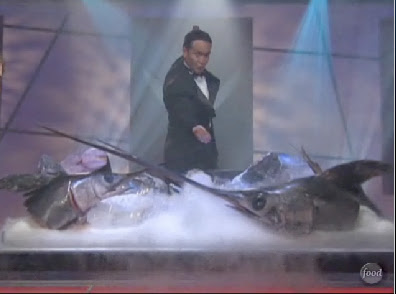
So it’s finally the finale, after six weeks and eight cheftestants. Hey, no one told me it was a black-tie affair! I hate black tie, but the Chairman looks good in his tux. After the obligatory montage of “how we got here” and scenes from the knife test at a basketball court to the grand dinner at the U.S. ambassador’s Paris digs, we switch to pure, Iron Chef America mode. Just the pulsating music and smoke machine gets me excited already. Let the battle begin!

We’re in kitchen stadium and so far it looks pretty empty except for Alton Brown, who’s also wearing a tux. Brown fits comfortably back in his commentating/hosting role of Iron Chef America, as opposed to his smug, annoyingly intrusive role as host in the last few episodes of NIC.

Brown introduces the two challengers and finalists, starting with Chef Clutch (Michael Symon). Wearing black, Symon has already got his Iron Chef battle face nailed down. We hear about his culinary rise to stardom with his Cleveland restaurants, and then there’s that laugh of his. It is booming.

All glowing in white, in comes golden boy Chef Big Easy (John Besh), who I had pegged for the finals from the very beginning. (Single Guy Chef pats himself on the back.) Looks like Besh cut his hair a bit shorter. Hope that doesn’t affect his superpowers. (Foreshadowing.)

Watching in the “skybox” are current Iron Chefs Bobby Flay, Cat Cora, and Masaharu Morimoto. Isn’t it weird how the Food Network doesn’t want to talk about Mario Batali? The rumor was that his contract never got extended with the network, yet they still mention his name and show his image on all these Iron Chef America intros. Weird. Hey, Bobby, sit up and stop slouching. You’re an Iron Chef, man!

The two finalists stand on opposite ends of the huge aluminum cover that contains the secret ingredient. (Well, not-so-secret if any of you saw previews at the end of last week’s show. Thanks Food Network editors.) It’s swordfish. With some pretty long swords, I might add. Both Besh and Symon look happy, grinning ear to ear. The Chairman does his “aaaaalleezzz cuisiiiiiine” and the two chefs start hauling away the fishes, with Symon adding a “who’s your daddy?” to show who’s boss.

Besh says his game plan is to be a warrior at heart and do what he does best, which is French-Creole-Southern-Louisiana-Jumbalicious cuisine. Symon says the first 10 minutes will be the most important in the battle, so he doesn’t waste any time and busts out a saw to hack away at the swordfish.

Both cheftestants are busy cutting into the fish, and in true Iron Chef fashion you know every part will be used. In fact, Besh is already roasting some bones to make a stock and I hear tell Symon is doing something with the neck. We’re introduced to floor reporter Kevin Brauch, who I can never seem to get past his odd pronunciation of words. It’s not like he’s saying something wrong, but the tone is just off in my ears. (Anyone who speaks Japanese and regularly watches Iron Chef America knows what I mean when you hear Brauch try to say “konbanwa” or “good evening,” usually right before he introduces the judges panel. Shivers.) Kevin does some mini recaps of what I just mentioned, but I’m mostly listening to Brown.It’s refreshing to get the old Alton Brown back. Here he is talking about the fish collar and stuff. This is where he shines. Wow, 15 minutes has elapsed. This is just flying by.

Commercials. Oh, the Food Network is doing a special holiday Iron Chef with Cat Cora and Paula Deen teaming up to battle Tyler Florence and Robert Irvine (of “Dinner: Impossible”). Sorry, but my money is on the guys. BTW, have you guys seen that commercial with Ben Stein talking about eating Alaskan seafood because it’s sustainable? Why is he wearing a suit and tennis shoes? Just asking.

Chef Big Easy is busy making corn blinis. Yum. Chef Symon just put some lamb tongues into the pressure cooker. Yuck. You have to give the guy points, though, for not shying away from exotic ingredients.

Brauch introduces the judges, thankfully without saying konbanwa. The judges from the series, food writer Michael Ruhlman, restaurateur Donatella Arpaia and Bon Appetit editor Andrew Knowlton are all smiling and happy, and also very dressed up. Knowlton just can’t seem to stop smiling.

While the cheftestants are busy making pasta, packing fish for immersion, and generally slicing up swordfish, Brown asks Ruhlman if he’s seeing Iron Chef action in front of him. Ruhlman says he won’t be able to tell without trying the food, but he likes what he’s seen so far. Donatella says something that I don’t remember, and Knowlton says he’s looking for creativity and someone who goes out of his comfort zone. Given that Chef Big Easy is cooking what he knows aka Southern cuisine, I’d say he’s at a disadvantage, at least when it comes to Knowlton’s vote. (Foreshadowing II.)

Floor reporter Brauch reports that a crusted swordfish is being seared. He goes over the ingredients and pronounces paprika as PAP-pri-ka. See what I mean? Shivers.

There has been very little dialog from the cheftestants so far, other than their video clips. But now Besh asks Symon how he’s doing, and Chef Clutch says he feels like a million bucks. Besh says he isn’t at a million yet. Maybe just a thousand right now. But with interest, he may catch up.

Brown takes this time to do a commercial for the new uniform for the Iron Chefs, which I guess will debut when the season begins next week. They had another contest for that, and the winning entry came from a mother-and-daughter team. OK, they talk about uniforms, but they don’t show any preview of what the winning entry looks like. And designer Mark Ecko is going to do the design, so what exactly did the mother and daughter do? Well, they got a free trip to New York at least.

Chef Symon seems to be doing really well, moving smoothly and now he’s already plating his marinated swordfish with salsa verde and a little neck clam. He’s also done with his swordfish cooked sous vide (slow cooked in a plastic bag). Typical sous vide results too: the fish looks uncooked and the color is bland. This is why I’m not a big fan of sous vide, even though it’s the in thing to do.

Commercials. For those of you in California, you’ve probably seen the PG&E commercials with the CFL light bulb talking to the regular old light bulb. I don’t think the commercial is that funny, but I do want to do a public service announcement and encourage everyone to use this energy-conserving bulb. You can find it in all the stores and it lasts for a long time so you don’t have to buy bulbs as often. Save the cheerleader, save the world.

The Chairman is pacing as usual. I wonder if he rehearses that pace? Chef Big Easy is poaching lobster tail to serve with his tempura-style swordfish. Actually both cheftestants are doing some kind of tempura dish. They’re also both doing some kind of pasta dish. This may be a close cook off. So far, I’m not digging Chef Symon’s plating. It looks simple and plain, and all on white dishes so far. Besh is also clean with white plates, but at least he does a bit more creative decorating with sauces.

Brown finally asks the three Iron Chefs about what they’re seeing. Bobby Flay says the two looks like they’re in good shape. Cora says something about staying strong till the end. Morimoto (and you know they had to turn on the subtitles for him) says he wants to see someone make dessert. Brown says he’s glad no one fired up the ice cream machine.

It’s not exactly ice cream, but Besh jumps into action to make a dessert dish—his seventh dish for the night. You know, both cheftestants only needed to make five dishes but Symon made six and Besh is now working on his seventh. It’s quality, guys, not quantity.

Besh’s team busts out some pastry dough that Brown says is like phyllo, but not really. So not really our friend phyllo but a distant cousin, brik. See? We learn so much on Iron Chef. Chef Besh is wrapping some swordfish concoction with marscapone cheese and vanilla and then deep-frying it.

Time’s up. Symon finishes a bit before Besh, who’s probably wondering about now whether it was a good move to make dessert in less than 10 minutes and using swordfish.

Judgment time. But Brown says there’s a twist from the Chairman. Instead of rolling out curmudgeon Jeffrey Steingarten, the judging will be done by the current three Iron Chefs. (Wow, what a slap to the face of the series’ judging panel who spent all those weeks eating and commenting. They get dressed up for the finale only to be told they won’t do the final analysis. I hope they at least get dinner.)

Brown throws it to the Chairman, who starts with the man in black, Chef Symon. Here’s his menu and comments from the Iron Chefs:

First course: Marinated swordfish with soy, sesame and yuzu, cooked sous vide style with lamb’s tongue underneath. He uses the old trick of loosening up the judges with a cocktail. Flay thinks the cocktail paired nicely with the fish but wondered about the tongue. Symon says he likes a bit of gaminess with his fish. Morimoto also thinks it’s a good start.

Second course: Olive oil poached sword fish, sliced thinly with cucumber and olives. Cat Cora thinks it looks like an Iron Chef dish but it didn’t have enough seasoning. Flay says it’s light to eat and has a lot of finesse.

Third course: Swordfish ravioli in truffle butter sauce. Cora thought the mousse inside the ravioli was more gritty than creamy. Morimoto says the fish has a mild flavor so he expects a lot more punch in the dishes from here on after the bland start from Symon.

Fourth course: Spice-roasted swordfish over roasted pineapple with pineapple salsa and a coconut and ancho chili sauce. Flay thought it was really balanced. Cora says it rocks. Morimoto does this weird thing with punches, doing these little pounding with his hands and saying in a quiet tone: “punch, punch, punch, punch, punch.” Everyone laughs. That Morimoto, what a joker. (Translation: Iron Chef Morimoto feels Chef Symon is slowly building in his flavor profile for his courses, getting stronger and stronger with each dish. Or like he said, “punch, punch, punch, punch, punch.”)

Fifth course: Crispy swordfish on a classic Greek sauce (I couldn’t understand the name; where’s the subtitles?!) topped with micro beets and greens. Cora felt it was bland.

Sixth course: Braised swordfish collar and chorizo stuffed into a clam paired with grilled swordfish. Bobby Flay does an “Oh. My. Gawd.” And Cora says “amazing.” Morimoto says “punch.” Looks like a home run for Symon on his last course.

Chef Besh presents his dishes:

First course: Seared and smoked swordfish. The swordfish smoked with applewood is under this cute little glass dome. It’s served with a corn blini and marscapone cheese topped with kettle fish roe from Louisiana. Besh also lubricates the judges with a glass of Louisiana wine. Flay says the fish was nicely smoked. Cora thought it was clever and delicate.

Second course: Besh calls this his swordfish crunchy roll—lobster meat wrapped with marinated swordfish served over buttermilk dressing. Bobby Flay says the dish is a trapping of an Iron Chef where you have so many ideas you want to execute but then the dish lacks focus. Ouch. Morimoto agrees, saying the swordfish has no flavor so it was overwhelmed when paired with the lobster.

Third course: Swordfish brandade agnolotti (this is Besh’s pasta dish). Cora says using the cheek was a bonus, and she liked the basil foam over the pasta. Morimoto likes it and calls it a success.

Fourth course: Breaded Swordfish. Besh ran white bread through the pasta machine to make thin slices, then baked with swordfish and covered it with hollandaise sauce. Flay says he likes all the ingredients, but he wanted something to cut through the richness—maybe heat or citrus? Cora agrees it needed something to jazz it up.

Fifth course: Chef Besh says this should have the pizzazz the judges have been waiting for (or at least he hopes)—blackened swordfish and shrimp in a broth made from fish head. Cora and Flay don’t think the shrimp was necessary. Morimoto is unusually quiet with his subtitles.

Sixth course: Swordfish piccata. Treating the fish like meat, he served it almost done with sautéed chanterelle mushrooms and a cauliflower puree. Hmm, doesn’t look good for Chef Big Easy. The judges have very little to say that’s effusive.

Seventh course: Swordfish dessert made with swordfish cream wrapped in brik pastry served with a reduced berry sauce. Flay says he couldn’t tell swordfish was in it, but he applauds the effort. Cora says she doesn’t taste the swordfish, and the secret ingredient needed to come out, or Besh shouldn’t have attempted it. Morimoto says “I like your challenging spirit.”

Besh says in his interview that the seventh dish was “do or die” for him. Either he’ll get extra credit for whipping it up, or he’d done himself in. We’ll find out after the break.

Commercials. California has a new commercial with Rob Lowe and a cast of other celebrities. Boy, did Maria Shriver’s hair get big.

This is the part of the show where they step away from the Iron Chef format. We’d usually get the announcement of the winner after the tasting, but instead we get a panel discussion like they have at those independent film festivals where you meet the stars. Brown is front and center and he’s flanked by the three series judges and the three Iron Chefs.

Brown asks the series judges to review how the two finalists did and really, at this point, do we really care? Let’s just find out if that Toronto Sun newspaper article spilled the beans and it’s true one of the two finalists has already filmed his new Iron Chef America episode? (Spoiler in the link, but really, you’ll find out in a few minutes below.)

Everyone agrees that Besh was slow and steady in this competition, while Symon had a shaky start but rose to the top with some surprising challenges. Knowlton just called Besh confident and somewhat “cocky.” Um, Andrew. Kettle. Black?

Brown then asks the Iron Chefs what they want to see in their new colleague, and Flay says he wants someone who can spin on his heals (it’s like Dancing With The Stars) and Cora says she wants a visualist (is that even a word?) who will interact with the audience while cooking. Morimoto says he agrees 100 percent with what Flay and Cora said. Everyone just laughs and laughs. Who knew Morimoto could be such a card?

Also, who knew Morimoto could draw? When Brown asks him who he’s voting for, Morimoto shows his decision-making process with these mini sketches of the dishes each judge presented. Then he starts talking about comparisons and scoring and it’s all a confused mess. The Iron Chefs speak briefly about whether it was a smart strategy to do a dessert at the last-minute. While some gave Chef Besh credit for taking a risk, Flay wonders if it was a smart risk to take when it’s the lasting flavor in the judges’ mouths? You see where I’m going with this, dontcha?

Instead of the typical Iron Chef scoring on taste, originality and plating, Brown just asks all the judges to write the name of who they think should be the next Iron Chef. This is just like grade school when you voted for who you wanted to be hall monitor. (I was always elected because I was such a nerd, but now I’m paying for it because I never hung out with the cool kids.)

Commercials. Did you notice Food TV has more commercials for itself than other advertisers? Or maybe that Ritz commercial with Rachel Ray is confusing me.

The Chairman is at his position, talking about the long road and hard challenges faced by the two cheftestants. Chef Besh looks worried; Chef Symon looks stern. Then in dramatic form (would we expect any less?), the Chairman unveils a big portrait under this red cloth and we get blinded by the spotlight shining off Symon’s head. Screams from the audience, and hugs all around. Oh well, so my favorite didn’t win as I predicted, but he came pretty close. And although I knew nothing about Symon before this show, I’ve learned that he’s gutsy, is a quick study, and is not a mechanic. He has his Iron Chef pose down so I’m sure he’ll do well as the latest chef to join celebritydom.

POSTSCRIPT: So the gossip on the blogosphere is that the vote for The Next Iron Chef was 4 to 2 in favor of Chef Symon, and the word is both Donatella and Knowlton voted for Besh while the three Iron Chefs and Ruhlman voted for Symon. Knowlton has some interesting insights about the final meals (scroll down to the Nov. 12 entry), which he thinks Besh succeeded. You'd think that more weight would be given to the final episode since this challenge of all the challenges in the series best reflect what happens in kitchen stadium. Big duh.

Saturday, November 10, 2007

When Cupcakes Are Too Precious

On a recent weekend, I was wandering the Cow Hollow area in San Francisco and I already made a mental note to myself to stop by Kara’s Cupcakes for her deliciously moist and creative cupcakes. But as the bus I was on passed a new, cute cupcake shop on Union Street, I decided to get off and give it a try.

That Takes the Cake is a pretty small, narrow shop but I give it high marks for brand appeal. I mean, its décor caught my eye from the bus so it must be doing something right.

The store, open less than a month, is the brainchild of Saralynn Reece, who only sold her cupcakes through her catering company prior to opening the Cow Hollow location. Now you can just buy one cupcake from the store instead of the minimum order of a dozen online.

Walking into the store, you feel like you’re in one of those trendy candy stores with glass chandeliers and oh-so-cute knick knacks for sale. To get to the cupcakes, you stroll down a long walkway to the back counter where the cupcakes are displayed and where Saralynn apparently has her mini office to juggle her new store and growing online empire.

I’ve mentioned before that my regular day job (no, I don’t get to cook all day) that pays the bill involves brand marketing. So I’m always impressed when someone excels both in brand copy and design. That Takes the Cake does this well with its décor and cupcake names, giving off a sophisticated but down-home fun appeal. Saralynn uses traditional cake flavors like vanilla, chocolate devil’s food cake, banana or red velvet and dress them up with precious names like “Sleepless in San Francisco” (chocolate devil’s food cake with coffee buttercream), “funky monkey” (banana with chocolate and pecan pieces) or “Gentlemen Prefers Reds” ( the red velvet with cream cheese frosting).

The girls behind the counter were very friendly and helpful. On this day, I ended up trying one of the red velvet cupcakes ($2.75). The cake was very moist but lacked any distinctive taste. But then again, I think that’s the whole idea behind red velvet cakes—it’s just moist and red. The frosting should have made a difference, but I found it a bit too sweet and light. I wanted it to be creamier and rich, but it wasn’t.

Overall, I thought That Takes the Cake was OK and the location is convenient when you’re window-shopping on Union Street. But when heading to the Cow Hollow/Marina area next time, I think I’d make the extra effort to go to Kara’s because their flavors are more creative and I’m addicted to their cupcakes oozing with soft fillings.

That Takes the Cake, 2271 Union St., San Francisco. Open Tues.–Sat., 11 a.m.–7 p.m.; Sun., noon–6 p.m. PH: 415.567.8050. Web site.

Friday, November 09, 2007

The Chinese Way to Build an Appetite

When our family would go out to dinners at a Chinese restaurant, one of our favorite dishes among the kids was called “shuen choy ngo yuk,” which in Cantonese translates to mean "sour vegetables and beef." “Shuen choy” or "pickled vegetables" is made of mustard greens, and when done right is this tasty, crunchy, sweet-and-sour goodness. Mustard greens are perfect for pickling because of their thick leaves.

Chinese moms would believe that feeding kids pickled mustard greens would increase their appetite just like how eating something sweet will make you feel full. So my mom would allow us to order this dish, which is sometimes considered a very common dish, in order to get us to eat the other dishes she ordered that night.

The key to the dish is getting the right pickled greens. My dad would sometimes make this fresh from scratch and refrigerate it, ready for my mom to make the dish at home. But of course, we'd often just sneak in (OK, mostly me) and just eat the pickled cabbage, leaving very little for dinner. I’ve never attempted to pickle the mustard greens myself, so often when I used to make this dish, I would go to a restaurant in San Francisco’s Chinatown that was famous for selling jars of really fresh and crunchy pickled mustard greens. Now that I'm in Oakland, I just go to a store in Chinatown and buy the packaged ones that are mostly imported from Thailand. Above is a photo of fresh pickled greens sold on the streets at a market in Vietnam when I visited earlier this year. It brought back lots of memory of this childhood dish. Enjoy!

Beef and Pickled Mustard Greens

Copyright 2007 by Cooking With The Single Guy

Ingredients:
6 oz. beef (sirloin or round tip), thinly sliced strips
1 package Chinese pickled mustard greens, diced (about 1 to 1.5 cups)
1 T soy sauce
1 T sesame oil
1 T Xiao Shing wine or sherry
1 T oyster sauce
1 T sugar
1 t grated fresh ginger
1 t ground white pepper
1 T cornstarch
1 T Canola oil

In a small bowl, marinate meat by mixing with pepper, soy sauce, sesame oil, ginger and Xiao Shing wine. Set aside for at least 10 minutes.

Remove pickled vegetables from package and rinse. Set aside to air dry and then dice into 1-inch chunks.

Warm Canola oil in a wok or skillet over high heat. Add beef (don't pour all the marinade in at once, reserve some for later) and stir-fry to brown all the sides (about 3 to 5 minutes) then toss in the pickled greens. Add sugar and oyster sauce and blend well. In a small bowl, mix a bit of water with cornstarch to create a slurry. Add this in slowly to your wok to create a gravy to bind all the ingredients together. If your wok is drying out, add more of your marinade or a bit of water or chicken stock. Garnish with toasted sesame seeds.

Makes 2 to 3 servings. Serve with steamed rice.

Pair with a glass of Pinot Noir.

TIP: The best pickled mustard greens to get for this dish should have a nice yellow-green color, not dull brown. It should also be crunchy, although sometimes that’s hard to tell in the packaging. Most Asian grocery stores will sell pickled vegetables in vacuum packs. Fresh versions are sometimes sold in jars in the refrigerated section.

Wednesday, November 07, 2007

Dish on Dining: Canteen

Make Dennis Leary Your Personal Chef
817 Sutter St. (at Jones), San Francisco
Nob Hill neighborhood
PH: 415.928.8870
Dinner with three seatings, Tues.–Sat.; lunch, Wed.–Fri.; brunch on the weekends
Major credit cards accepted; reservations recommended for dinner, no reservations for brunch
www.sfcanteen.com


Canteen is the type of comfortable hole-in-the-walls that you’d make a regular hangout for dinner in the neighborhood. But Chef Dennis Leary (not the actor who spells Denis with one “n”) has churned out such impeccable dishes from this 20-seat restaurant that he’s made it a culinary destination.

I mean, during my first visit to Canteen recently for brunch, I sat at the counter next to a couple of girls who drove up from San Jose for a weekend in the city. Canteen was the first stop on their list of “foodie places” to try.

Situated on the ground floor of the Commodore Hotel (which sounds fancy but the hotel was turned into dormitories for Academy of Arts students), Canteen opened in 2005 as a way for Chef Leary to escape the big kitchens (he formerly cooked at Rubicon) and experiment in the intimate settings of a tiny restaurant.

And boy is it tiny. The counter seats seven people and the four booths lined along the wall really comfortably seats just two people per booth (you can squeeze four into the front booth). The décor can be described as funky—part library, part Art Deco furniture store. And the tiny kitchen where Leary does most of his cooking could be the prep station at most restaurants.

Despite the space restrictions, Canteen blossoms as a full-fledge restaurant, offering dishes that are tasty and complete. While dinners can be quiet elegant, it seems the bigger draw is weekend brunch.

So that was my first visit. Canteen doesn’t take reservations for brunch, so one Saturday I arrived at 11:40 a.m. and took the last barstool at the counter. Soon after I sat down, there was a constant stream of people coming in checking on availability and putting their names on the waiting list.

The menu, not surprisingly, had a limited number of dishes. But I was surprised that it offered an even share of breakfast items and typical lunch entrees. I decided to start with the seasonal pumpkin soup ($6.50) and ordered the smoked salmon omelette ($9.25), mostly because I love lox.

The pumpkin soup had a beautiful color when it arrived, and was just as satisfying in taste. Topped with roasted sunflower seeds and parsley, the soup was aggressively seasoned with a mild squash flavor. What I mean by “aggressively seasoned” is that it had a strong savory taste but didn’t taste salty. My friends who are on low-sodium diets will probably think it is way too salty, but I liked it.

My omelette came with a fennel salad on the side dressed in a light vinaigrette and some toast with home-made marmalade. The eggs were perfectly done, encasing the salty lox inside and a big dollop of cream cheese. While I enjoyed eating the omelette and the fennel salad, I didn’t necessarily think the two married well together on the same plate. Still, each tasted delicious on its own.

Side note: My counter partner from San Jose had the blueberry pancakes, which she enthusiastically endorsed.

Feeling good about my brunch experience at Canteen, I decided to return a week later for dinner. Again, because the place is so small, reservations are recommended for dinner and you have to be aware of the seatings. When the place is open for dinner, you’re seated at either 6, 7:30 or 9:15 p.m. Because Chef Leary does all the cooking, the total number of people served (known as “covers” in restaurant lingo) is about 30 to 35 a night. That’s not a lot of people, which made me wonder how much money Leary can really be making in this intimate setting.

I ended up going to Canteen on a Tuesday night, which is also when a prix fixe menu is served for $38 (starter, entrée and dessert). Unlike other prix fixe menus, Canteen’s prix fixe doesn’t offer any choices. So in a way, it’s like a chef’s mini tasting menu because the decisions are made by Leary as to what will be served.

I walked in expecting the entire room to be filled like it was for brunch, but instead it was just me at the counter and two parties at two booths. That’s when I realized that the maximum reservations per night are spread throughout the three seatings to make sure Chef Leary isn’t overwhelmed. (So a warning: if you plan to go to dinner alone hoping to chat with others at the counter, bring a book just in case no one is seated around you.)

My dinner started with an amuse bouche from the chef—a roasted duck and fresh porcini mushroom crostini. It was enjoyable, although my sliver of duck was a bit large so I couldn’t eat it in one bite, but the meat was cooked rear so it was difficult to bite into. Still, I did my best to eat it all as one bite.

Then came a celery root soup with salt cod, bacon and fennel. Even before the bowl hit the countertop, I could smell the essence of celery (and I personally love celery unlike some celery haters on some discussion boards I’ve visited). While this soup lacked color, it was full in flavor just like the pumpkin soup. I am now a fan of Chef Leary’s soups; I don’t think he can make a bad one.

The entrée was spice-crusted venison with seasonal fruit chutney and roasted potatoes. I had to laugh when I saw this on the menu because just the week before I was writing on this blog in my recaps of “The Next Iron Chef” about how so many of the cheftestants were cooking venison—it’s like the designer meat of the moment. I’ve never had venison, which is basically Bambi (OK, a grown up Bambi), but my server told me it’s very lean and less gamey now that a lot of venison are farm-raised.

The venison were served as medallion and perfectly cooked by the chef. It was red enough to be tender, but not at all chewy. While I could tell that the venison meat was very lean, it still tasted moist with the fruit chutney and the jus on the bottom of the plate. While I can’t say I’ll rush out and seek out another restaurant serving venison, I was glad that my first exposure to this meat was under the skillful hands of Leary.

The evening was capped off by dessert—lemon croquettes with pistachio sauce. While I’ve talked again and again about my wariness of eating fried foods, I can’t argue with croquettes that have a light, thin fried layer oozing out with warm lemon curd when you break into them with your fork. I thought the additional lemon sauce on the plate was totally unnecessary, but that didn’t deter from the elegance and simplicity of this dessert.

I called this posting “Make Dennis Leary Your Personal Chef” because in many ways you’ll feel like Leary is cooking just for you when you’re seated at his intimate yet sophisticated diner. Leary must be the hardest working chef of his caliber in town because he is always behind the stove preparing the meals while keeping one eye on the room, directing servers to go to a table that might need attention or alerting them to when a plate is left sitting too long. He’s like a maestro in the back orchestrating the culinary symphony occurring up front. And when done right, the music wafts beautifully into the cool night of San Francisco.

Single guy rating: 4 stars (flavorful soups and elegant brunch)

Explanation of the single guy's rating system:
1 star
= perfect for college students
2 stars = perfect for new diners
3 stars = perfect for foodies
4 stars = perfect for expense accounts
5 stars = perfect for any guy's dream dinner

Canteen in San Francisco

Tuesday, November 06, 2007

Beyond The Next Iron Chef: A Conversation with Chefs Chris Cosentino and Traci des Jardins

For those of you following my recaps of the Food Network show, “The Next Iron Chef,” you’ll know that this series boasted two amazing chefs from San Francisco. Traci des Jardins, a 2007 James Beard award winner and the chef behind Jardinière, Acme Chophouse and Mijita Cochina Mexicana in the city, had the distinct honor of being the cheftestant eliminated at the end of the first show. Chris Cosentino, executive chef of Incanto in Noe Valley, went as far as the top three but was eliminated in this past Sunday’s episode.

I was fortunate enough to do an interview with both chefs for my blog. Although they’re both in San Francisco, it would have been an organizational nightmare to find a time when the two busy chefs could be in one room. So instead, I did this interview via e-mail.

This interview was also compiled in the days prior to this past Sunday’s episode. So answers from Chef Cosentino don’t reflect his recent elimination.

One final note, I typically do these Q&A’s identifying myself as Chef Ben, which is the user name I made up for my blog. But being in the presence of such distinguished chefs, I didn’t feel it would be proper to call myself a chef in the same posting. With that said, the following are edited excerpts from my e-mail interview.

Ben: What made you decide to enter this competition to be “The Next Iron Chef”? Some people say the stakes are higher for the competitors of this show because all of you have built up a reputation on your own already and a departure from the show may be viewed as a failure. Did that ever cross your mind?

Chef Chris Cosentino: I’ve wanted to be on Iron Chef since back in the days when it wasn’t even translated into English. This was the opportunity of a lifetime.

Chef Traci Des Jardins: I had a great time when I went on Iron Chef the first time, it was a wild ride, very challenging, but ultimately an absolute blast. Chefs and restaurateurs are in a risky business, I have always been an adventurer and am willing to take risks, this was no different really. Every time one opens a restaurant, they are risking failure and it is certainly true that many great chefs have tried and failed for whatever reason. The show is really no different, just a different medium. I, of course, knew going into this that it was a probability that I might not win, I was simply willing to take on that risk.

B: San Francisco was the only city to boast two Iron Chef contestants, even more than Manhattan. What do you think that says about the restaurant world in the Bay Area?

TDJ: I think that the Bay Area is a Mecca for chefs, restaurants and foodies so it is not surprising to me that they selected two contestants from this area.

CC: I’d attribute this to pure luck more than any attributes to the Bay Area’s restaurant scene.

B: What were you hoping to showcase about your cooking style or philosophy on the show, and do you think you had the chance to do that?

TDJ: I don’t think that I necessarily had a chance to exhibit my style and cooking philosophy given how quickly I was eliminated from the show and the challenges that I participated in. Given that the major challenge that I was eliminated in was pastry, and pastry with a curve ball, I think that it only really represented a very narrow area of abilities (or lack there of—LOL).

CC: I wanted to show that offal can take center stage in everyday food, and I had some opportunities to do that.

B: The two women in the competition were eliminated back-to-back on the first two episodes of the series. Pure coincidence or do you think this reflects anything about the current state of women in the restaurant business?

TDJ: I don’t think that the first two out had anything to do with the fact that we were women, we just happened to be the two women.

CC: The eliminations were based on particular food-oriented competitions on those days. To think they are reflective of the state of women cooking in America is inaccurate.

B: Chef Cosentino, in the science challenge you seemed really frustrated with the technical and scientific gadgetries you had to play with but then you were able to pull off the win. What did you do to deliver the winning razor clam dish? Are you going to put it on the menu at Incanto?

CC: I focused on one technique that made sense to me and tried to apply it to an ingredient I was familiar with. No, it’s not going on the menu.

B: After your win, you had the upper hand in the following week’s challenge when you paired chefs together. Did you have a strategy going into that challenge and do you think it worked? I have to say, Alton Brown seemed pretty suspicious about whether you really took full advantage of your position. Do you think you could have done more to sabotage your competition?

CC: This was not about sabotage but great cooking under pressure, so no, I don’t think I would have done anything differently.

B: What were your thoughts about the judging process? You read reviews about your cooking, I’m sure, all the time. But here you’re getting instant reviews right to your face about your food. What was that experience like?

TDJ: We are rarely faced with that kind of immediate judgment, so it was very difficult. I think that it was equally difficult for the judges, these are three people who are dedicated to and live their lives in the food world—and who really love food and chefs—they are there to judge though and to discern what is the best in that moment, indeed a very difficult job. So the process was hard, for the judges and for us.

CC: It’s like everyday at my restaurant. Customers tell me right then and there when they like or don’t like something. At the restaurant I get to come back and fix things, on the show, I could get sent home.

B: All the chefs seemed to have a good camaraderie in the kitchen. Did you enjoy working with the other chefs and did you learn anything about cooking from your fellow competitors?

CC: Yes and yes. I talk to my fellow competitor chefs all the time.

TDJ: I loved all the chefs I worked with on the show—it was an absolute blast getting to know them and working together on that wild ride that was the “Next Iron Chef.” I don’t think that we really had time to learn about cooking from one another though.

B: All the contestants, including yourself, were previous competitors on Iron Chef America. Which was harder to do? Cook a secret ingredient in an hour or do the various challenges to be the next Iron Chef?

CC: The Next Iron Chef. Cooking in the Kitchen Stadium is a more predictable situation because you know what your equipment and playing field are, you just don’t know your ingredient. NICA had many more variables so it was more challenging.

TDJ: Not all of us had been competitors on the show. John (Besh), Morou, Michael (Symon), Chris, Aarón (Sanchez) and myself had all been on the show, Gavin (Kaysen) and Jill (Davie) had not. “The Next Iron Chef” was much more difficult, many more unknowns and unfamiliar territory and no support staff. As chefs we are used to working together with large teams of people all of the time, we are collaborative by nature, perhaps the most challenging aspect was not having a team to bounce stuff off of, although we did collaborate with each other to some degree.

B: OK, I’m sure you can’t say anything about the finale or the winner, but can you say who you think should be in the final match up and why?

CC: I’m unable to comment on this. (Again, just a reminder that Chef Cosentino answered these questions before this past Sunday’s elimination.)

TDJ: There are three left at this point, obviously they are all very worthy and the finale will be a great one.

B: What’s next for the both of you in your food life? Any changes we should expect to see at your restaurants? Working on any books? Any chance you’ll be on TV in the near future again?

TDJ: I will keep doing what I have been, running my three restaurants, trying to make them the best they can be every day. Jardinière just celebrated its 10 year anniversary and I want to make the next 10 as magical as the first. No book projects currently and I will always be open to doing TV again.

CC: I’ve just launched Boccalone, an artisanal salumi company and I’m at work on the definitive cookbook on offal. As for future TV appearances, stay tuned to see what happens...

My thanks to Chefs Cosentino and Des Jardins for taking part in this interview.

The finale of The Next Iron Chef airs this Sunday, Nov. 11, at 9 p.m. on the Food Network. Photos courtesy of the Food Network.

Monday, November 05, 2007

The Next Iron Chef: Episode 5

Viva la Lobster Roll

Previously on the NIC: The four cheftestants took flight with the Top Chef-airline-food do-over, but it’s Chef Aarón Sanchez that’s left grounded on the tarmac. Tonight: Chef John Besh is changing his name to Jean Besh and is getting all French with his bad self. The final three are planning a party at some big estate in a style that can only be thrown in Paris, or the parlor of Elton John’s home.

It’s getting close to the finale and you can tell by the pre-show interviews with the final three that they can taste victory (or as we learn later in the episode from Chef Clutch, or Michael Symon, it’s victoire). The three arrive in Paris, a very cold, damp and wet Paris. (Chef Symon and Chris Cosentino, I have a message from your moms: “Did you leave the house without your coats and mitts again?”)

With the iconic Eiffel Tower in the background, the three walk up to Alton Brown, who’s dressed mysteriously in a tan trench coat looking like he’s about to pass the latest clue for solving the Da Vinci Code. With his obligatory French greeting, he mentions that Paris is one of the Chairman’s favorite cities in the world. But still, that hasn’t enticed the Chairman to make a personal appearance because we still get the Chairman-in-the-Box, revealing the latest challenge.

The Chairman says Paris is the place where people come to gain culinary knowledge, and as Iron Chefs they’ll need to be “commanders of the kitchen.” So we can guess that this episode will focus on the oddly named culinary skill of “lead and inspire.” (I say odd because I would have just labeled the skill as “leadership,” and by definition most leaders are inspirational. The Chairman needs an editor.)

Brown passes out red envelopes containing 2,000 euros (or $2,500, dang the dollar sucks in Europe) and gives the cheftestants three hours to grocery shop for a three-course menu for 20 guests later that night. The menu must represent the best of American cuisine. Chef Big Easy (Besh) asks where they’ll be cooking, but Brown won’t tell him and pretends to keep it a secret. For the viewers, we already know because the Food Network editors are awful at building suspense. Still, I won’t be a spoiler on the exact estate they’re cooking at.

Chef Bad Boy (Cosentino), who’s known for his Italian culinary style, says being asked to cook American food in France is “twisted.” Like a pretzel? They all run down the steps to three unmarked vans waiting for them. Cosentino gets there first, followed by Besh and Symon picking up the rear. So any viewers of “The Amazing Race” will know what happens next. Yep, Cosentino gets in the first car but it’s the one with the clueless driver who doesn’t know his way around the city. (And yay to TAR returning on CBS. That gives me another hour of unscripted television to watch for the next few months with the writers’ strike officially beginning today.)

The next few shots are of the three cheftestants (well, Besh and Symon, at least, since Cosentino is still circling the Paris streets with his driver) shopping at a variety of French stores with Chef Big Easy looking all calm and sexy speaking French. I have to say, I loved shopping in Paris when I was there. The stores were quaint and sophisticated, the ingredients always top-notch, and the displays were fantastic. Looks like the cheftestants are getting the same experience.

So as they’re shopping, we get an idea of the cheftestants’ menu formulating in their minds. Besh is buying crab meat and caviar, so you know he’s highlighting his New Orleans roots (or as he says later, Nouveau Orleans). I’ve learned so many French terms on tonight’s episode that I’ll probably never use in future conversations.

Chef Bad Boy, finally out of his van and shopping, is looking to make a Philly cheese steak while Symon’s going wild for all the wild strawberries in a store, buying the whole lot. Besh is going on and on about all sorts of things he’s thinking of making. He is really excited about this challenge.

Chef Symon drops more than $700 to buy fresh lobster, which he says he’s going to make into a lobster hot dog. Huh, I don’t think I’ve been in any ballpark in the United States that offers a lobster hot dog, but I’d sure like to try one. (And you can bet either Fenway Park or AT&T Park in San Francisco should be the first to have it in their stands.)

Commercials. Kia and the traveling giant red ball on a stick. I still don’t get
it. (BTW, the rest of the commercials throughout this episode were so boring that this was, unfortunately, my first and last commentary on the commercials for the rest of this recap.)

Chef Cosentino is running around buying a whole lot of food, and now he’s searching for burrata cheese, which he can’t find but find’s something close. The French sales clerk at the cheese shop seems almost shocked that Cosentino says he plans to make a sauce out of the cheese he’s buying. The guy says the cheese is too expensive to make into a simple sauce. But Cosentino says he doesn’t care about the costs. Oooh, how bourgeois.

Chef Big Easy is buying something called Cock’s Comb. Come on, he said it, not me. (I’m still not clear what it is but I think it’s the rubbery red part of the rooster. I’ve seen online definitions referring to it as a flower. I’ve also seen spelling like coxcomb, which is probably more acceptable for a family paper.)

Done with their shopping, the cheftestants arrive at some big estate, still not sure who’s their host. Chef Besh is feeling pretty smart that he wore his blue blazer, compared to Symon and Cosentino dressed in T-shirts and jeans.

Brown’s waiting for them outside the huge palace-home, and informs them that the home used to be owned by a baroness, and then someone from the Rothschild family. But now it’s the home of the U.S. Ambassador to France, Bush fund-raiser and distant in-law Craig Stapleton. Talk about political plums. Stapleton does the obligatory greeting and lets them know they’ll be cooking for a bunch of French cooking snobs, err, guests.

Inside the enormous kitchen (how much does one ambassador eat?), Brown tells the cheftestants that an Iron Chef must be able to lead a crew into battle in kitchen stadium. So the Chairman has assigned each of them a sous chef, who will help them during this challenge.

The three sous chefs are from France, but they all seem really focused and appear to take instructions well. The cheftestants look excited about this challenge. In fact, I think Chef Bad Boy is doing a little dance before he gets cooking, or is that his imitation of Rocky? They have three hours to finish their three courses.

Chef Big Easy works on his chicken and dumpling. He’s really emphasizing his Southern cooking, which is definitely his style but I thought the judges said a couple of weeks ago that they were getting tired of that? Chef Clutch (Symon) in the meantime is having a lot of difficulties with all his equipment and he looks like he’s stressing out. He’s also making meat loaf with ground liver. And you know what? It looks just like how it sounds.


Cosentino is making a lot of noise in the kitchen, running all around, and Besh calls him “a loud American.” Besh, in the meantime, looks confident and is quietly working in between snippets of French he’s throwing around to maintain his sexiness.

One hour is left in the cooking, and I’m surprised that in this episode Brown isn’t annoying all the cheftestants with his smug self. His annoying questions are held down to a minimum, giving us a clear view of the cheftestants working on all their three dishes.

The guests arrive, starting off with a fancy-shmancy (got that from Amy) cocktail party at the garden.

Chef Symon starts working on his truffle potatoes. Cosentino is mad at himself for dressing his lettuce too early (now they’ll be a bit wilted at service), and Besh shows the first signs of frustration over a fryer. The cheftestants move into presentation mode and they all have to run up some flights of stairs to the dining area to lay out their food. What was odd is that later in the show the plates were brought to the guests at a table, so not sure who the presentation was for and if anyone even saw it?

Time’s up. And Brown yells out: “No more foodie touchie.” What? Is this kindergarten?

Dinner is served, and the judges are mixed in with a bunch of guests. I feel sorry for judge Michael Ruhlman who seems to have been seated next to a food critic who has an opinion on every dish and food ingredient used or not used.

For the first course, Chef Big Easy delivered a crab meat BLT with a fried oyster and caviar, Chef Bad Boy made a lobster roll as a homage to his New England upbringing, and Chef Clutch also served up lobster but in the form of a hot dog. Plus, he does this really loud thunderous laugh but I already forgot what was so funny.

Judge Donatella Arpaia, the restaurateur, loves Symon’s hot dog, and so does a French woman two seats down, who says she loved the texture. The French guy thought it was a crime to hide caviar behind bacon (Besh’s dish). Gosh, these French people are critical, but you know what? It’s the most insightful and discerning comments all season. Hmmm, if I were the judges, I’d be looking over my shoulders.

Next course: Besh offers up his chicken and dumplings, Chef Symon shows off his veal meat loaf with duck liver and truffle mashed potatoes, and Cosentino presents his Philly cheese steak, which looks more like a deconstructed cheese steak without the bun. The meat loaf gets mixed reviews and Donatella is looking for the speck of crouton on her cheese steak.

Final course—dessert: Chef Cosentino does this college trick where he shoots up melons with alcohol, calling his dish Melons and Moonshine (using grappa and honey). Symon makes a rootbeer float that looks very red, white and blue with his blueberries, strawberries and cream. Besh talks about his four sons eating watermelon every day and how he made a strawberry shortcake with watermelon sorbet. It’s presented very nicely.

At the end of the meal, Donatella and Brown have this weird interchange when Donatella’s talking about how there’s a sure winner in some people’s eyes and Brown is getting all bossy saying there shouldn’t be a winner in this challenge, just a loser with the other two named the finalists.

The guests are gone and the judges and Brown are assembled in one of the rooms and they start to pick away at the dishes. Ruhlman loved Besh’s crispy oyster and the complexity of the dish. They don’t seem to like the lobster roll from Cosentino, and Andrew Knowlton is getting a bit superior about food knowledge by questioning Donatella’s knowledge of what makes a proper lobster roll. It’s bad enough that he asks, “Do you know what you’re talking about?” But he adds another twist of the knife by adding “do you?” for good measure.

Knowlton’s favorite is Symon’s veal meatloaf with the chanterelle gravy. But they all couldn’t taste the truffles in the mushroom. (The judges probably didn’t know that Symon couldn’t find fresh truffles so he used a truffle paste. And what’s odd about that is Ruhlman says he thought he had one sliver of truffle on top of his dish. So what exactly was he eating?)

In the dessert round, Ruhlman felt the cheftestants’ offerings really summed up their cooking style. And in case you didn’t get it, Ruhlman sums it up for us this way: Chef Besh with a complex and composed shortcake, Chef Symon’s playful and little sloppy rootbeer float, and Chef Cosentino’s bold, hearty and simple melons.

Donatella thought Cosentino’s alcohol-infused melons were simple, but she liked the execution, saying she’s had bad melons. (Which frat party was that Donatella?) But she wonders if the dish was worthy of an Iron Chef. Knowlton, of course, wrote it off as just a fruit salad.
Ruhlman liked the execution and presentation of Besh’s shortcake, but he didn’t like eating it. (He explains later on his blog that he found out Besh used store-bought biscuit, which is probably why he didn’t like it.)

At nightfall in the City of Lights, the three cheftestants return for judgment. Brown says he’s really proud of the three, and says they represented their country well. Since they’re not naming a winner, Brown stretches out the suspense of who’s going home, but really, the writing was on the wall all along that it’d be Cosentino. In fact, it would have been a shocker if Cosentino made it to the final over the surging Symon and the constant front runner Besh. Still, the sad music plays after Brown finally announces that Cosentino will not be the next Iron Chef.

Chef Cosentino says his goal was to make it to the finals. Just a tad short of that goal, he still feels proud that he made it to the final three and went out with a strong showing. He gets hugs from his fellow cheftestants and as he leaves the room, we see his blond faux hawk perfectly backlit from the studio lights.

That leaves Chef Big Easy (Besh) and Chef Clutch (Symon) as the final two, making them the finalists to go head-to-head in a winner-take-all battle in kitchen stadium. Despite Symon’s strong showing in the last few episodes, my bet is still my initial guess, John Besh. Let’s see if I’m right next week.

Next time: It’s the finale of the series and the Chairman finally makes an appearance. The final battle is fittingly in kitchen stadium, and Iron Chef Bobby Flay is there to dispense advice. And this being the Food Network, we already get a spoiler on next week’s secret ingredient. Looks like sword fish.

Coming tomorrow: Check back here Tuesday night when I post my special Q&A interview with the two San Francisco cheftestants—Traci des Jardins and just-booted Chris Cosentino.

The Next Iron Chef airs Sundays at 9 p.m. on the Food Network with repeats at the same time on Thursday. Finale is this Sunday, Nov. 11. Photos courtesy of the Food Network Web site.